






The museum as an exhibit
The Jewish Museum – Berlin, 2001
Daniel Libeskind
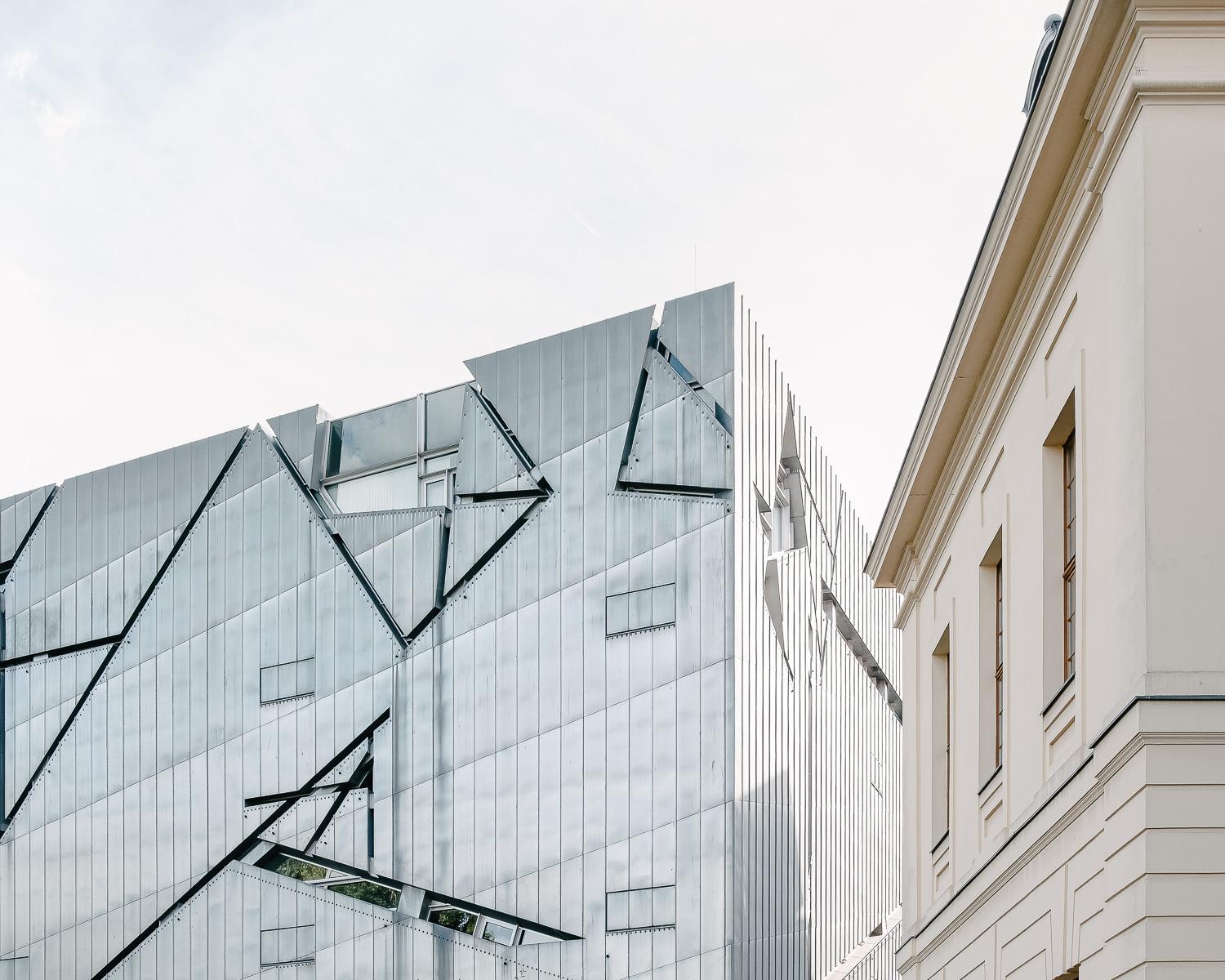
There are two slabs supporting the structure of a city. One of them would be its architecture and the other its historical heritage. Holding them together forms an unharmed base of the precedent. Coming as a gift to the past, Jewish Museum captures these two dimensions of Berlin’s transformation and evolution, it incorporates them and becomes Daniel Libeskind’s “Between the Lines”. The Jewish Museum of Berlin opened to the public in the fall of 2001 and hosts a permanent exhibition of the repercussions of the Holocaust. The new building is placed next to the site of the original Prussian Court of Justice building, completed in 1735 which now serves as the entrance to the new building. The building depicts the cultural side, that of collective memory, mentioning an evidence of sobriety and mourning of events already consumed. The structure, beyond the strong concept of the edifice, is not only in the walls, but in the place and its chronicle. I had the chance to see the construction only from the outside in the summer of 2019. I could notice its sharp corners, the serious facade, which seems to leave a shiver of what it hides, the discontinuous slots that do not announce the level differences. I still manage to intuit from the sharp and cold character of the exterior and from the frames captured by Niccolo Vonci that it is a place of living the presented feeling, that it itself becomes an object to be exhibited. Yet bringing architecture to the forefront, the first essential thing to meet are the lines. “The official name of the project is ‘Jewish Museum’ but I have named it ‘Between the Lines’ because for me it is about two lines of thinking, organization, and relationship.” —Daniel Libeskind Looking at the museum from above, we may notice only one of them, the zig-zag made of zinc-titanium; the other line is invisible and straight, imaginarily joining the two ends of the building. Spotting the intersections of the two lines, we discover empty spaces, open on the entire vertical axis as a conscious cut from the basement to the roof, “the voids”, expressing the presence not of a physical emptiness, but of the mental one, left as a result of the Jews extermination during the Holocaust. The same as the great creations that are based on difficult controversies of existence, the museum has its references both in the personal experience of the architect, the loss, but also in previous works of particular impact also raising the issue of the massacre of Jews in Germany, which are, as Daniel Libeskind mentions prominent Jewish and non-Jewish Berliners such as Paul Celan, Max Liebermann, Heinrich von Kleist, Rahel Varnhagen, and Friedrich Hegel and also Arnold Schönberg’s unfinished opera Moses and Aaron, from the German Federal Archive’s The Memorial Book for the Victims of the Nazi Persecution of Jews in Germany. Niccolo Vonci shows us the emotional process between the walls, the constraint of the structure that seems to leave room for a single person to discover it. Inside the void you are alone with yourself receiving the consciousness of the voices that lived the torment. Meeting this space of absence and the reality of lack, you wake up with a psychic load that no longer seems to be empty, it cannot be characterized as “nothing”. The void thus becomes full which is why it doesn’t require more than a shred of light to reach it’s last purpose, the release. Therefore, if a room in architecture needs furniture, finishes, electricity, heat, a room in feeling only needs root recognition. As for the actual course of the rooms in the development of the project, the lower level is crossed on three axes: the Axis of Exile, the Axis of the Holocaust and the Axis of Continuity, which symbolize three historical developments of Jewish life in Germany. The Axis of Exile attests to the pre-existence and presents the historical part, preserved mementos which families took them along when they emigrated. The Axis of Continuity leading to the exhibition galleries, symbolizes the continuum of history ending in a steep staircase which is touched by a projection of light cast onto its upper end. On the Holocaust Axis, the most difficult to travel, there are letters in German, photographs and objects of those who died. Beyond a heavy door the Holocaust Tower appears, named as the “Voided Void”. Through a new narrow slit, light also enters the Holocaust Tower, reaching unheated concrete as the only evidence of the existence of an outer space. As a visitor, the sensation acquired at the end of the route would be found mainly in oppression, or even in a bit of insecurity, but at the same time in belonging to a history that is still expected to be thought out and analyzed. The whole building, as it is perceived as a masterpiece of architecture, firmly fixes its assumed and fulfilled goal, presenting itself as a museification of the trauma from the structure to the imaginary.
Words by Nela Andries


